
We are continuing the focus on safety that began with last week’s blog on The Human Factors That Affect Our Safety, which introduced the Deadly Dozen. This week, I would like to call attention to the ways in which we are improving our communication about workplace hazards. I am excited to raise our game by making it easier for all of us to identify hazards and know what PPE we should be using when working near the many hazards of shipbuilding.
Late last year, we started discussing how we want to communicate more effectively about workplace hazards, PPE requirements and other safety-related information. I have found that I tend to respond to visual cues – like the ones we get when we are driving, for example: stop signs and lights, caution signs or different colors of painted lines on the roadways. Different symbols, shapes and colors tell us what we need to do when driving our cars. You pick the sign – it has a meaning which we’ve learned so we understand what action to take.
Have you bought a tool lately? I bought a table saw last year; the instructions were full of pictograms. Walk through a major airport? Pictograms tell passengers where to go, like a suitcase picture representing baggage claim. Been in a hospital? Again, full of pictograms. Think about all of the warning lights in your car or truck – all pictograms.
As we recognize how we receive information from all of these different sources, it is clear that we are becoming more comfortable interpreting pictograms and understanding their messages. Starting from that premise, in our discussions about making safety communication more effective, it became clear that using more pictograms in the yard could convey important information to all employees in an easy-to-understand way.
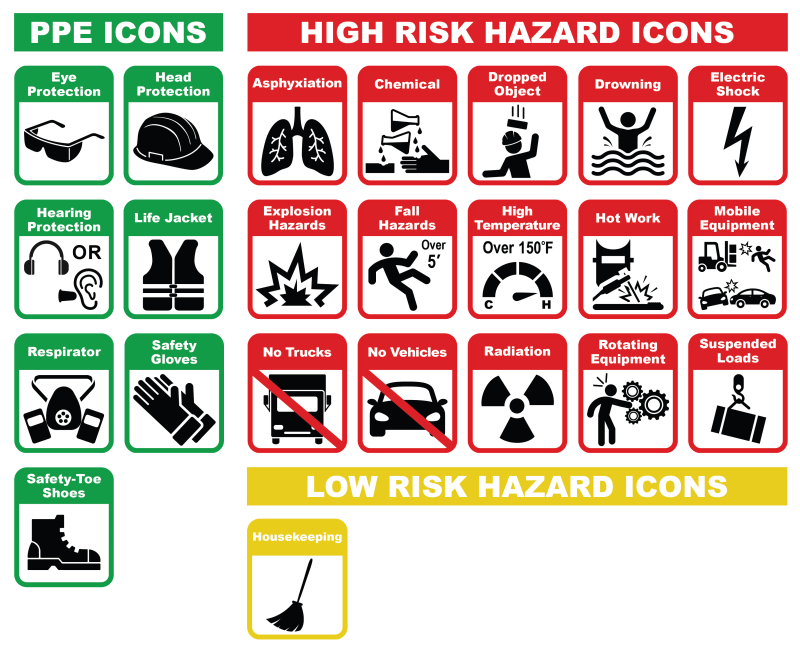
Using pictograms to communicate safety information then became a project with a plan. First, we had to standardize the pictogram format and then create a graphic to represent each one of the most dangerous hazards in our work environments. Next, we had to identify each area of the shipyard and make sure every sign had the appropriate PPE and hazards listed for those areas. This is a big undertaking for many departments – especially the Sign Shop, which is producing the new signs. Safety, Business Continuity, Communications, Training and Facilities are also playing major roles in this project.
The chart on this page shows the BIW safety pictograms that are now appearing throughout our company. These signs indicate required PPE in GREEN and dangerous hazards that you need to avoid or be aware of in RED. We are also introducing some “low risk” hazards in YELLOW – think “caution.”
This will be a live project that will get updated as needed or when situations change in the company. For example, if we get new equipment that requires specialized PPE or has a new hazard, then we will update the list with a new pictogram to make people aware of the new requirements.
These pictograms are being incorporated into new hire training as well as our OSHA 10 and OSHA 30 safety courses. You will also see them on safety talks in musters. Better understanding of what can cause an injury will help everyone on our team better avoid getting hurt at work.
I wanted to use this blog today to introduce these to you. If you have any questions about them, please reach out to the EHS team for assistance.
See you on the deckplates!
Safely Execute High-Quality Work
Chuck
President, General Dynamics Bath Iron Works