Facts
Tidbits of Bath Iron Works history, trivia and notable milestones.
-

-
Modern Era
Pier Support Center
As BIW accelerates the DDG 51 Program shipbuilding rate, Pier 2 has become an essential location for execution of post-launch ship construction work. This pier, compared to Pier 4, has…

-
Great Depression and WW II, Post War America
Boiler Shop History
Designed to support the assembly/erection of steam boilers for U.S. Navy WWII destroyers, the Boiler Ship was used for more than 50 years.

-
Lead Shipyard for DDG-51 Destroyers
In 1985, BIW won the competition for detail design and construction of USS Arleigh Burke (DDG 51), the Lead Ship for the Navy’s most capable class of AEGIS guided missile…

-
The New Nation – 1880
Shipbuilding on the Kennebec River
Shipbuilding has been a way of life along the Kennebec River in Bath, Maine, since 1762, when the sailing ship Earl of Bute was launched on the site of present…

-
Portland Repair Yard and Todd-BIW Yard
During Bath Iron Works’ rich history, we expanded to other areas of Southern Maine depending on our needs. During War World II, from 1940 to 1945, there were two Todd-BIW…

-
Keyes Fibre Company
After WWI, there was a slump in shipbuilding. BIW Ltd. went into bankruptcy and all tooling was sold at auction. Keyes Fibre Company of Waterville decided they wanted to produce…
-
Harding Plant (Structural Fab)
Originally called the Harding Plant, the Structural Fabrication Facility was built in 1940 after then-BIW President William S. “Pete” Newell received a telegram from Secretary of the Navy Frank Knox.…
-
Industrial Production
During the 1950s and 60s, Bath Iron Works looked to industrial production to fill in gaps in the shipbuilding schedule. Some of the jobs included fabricating submarine hull sections for…
-
Shipyard Modernization
In the 1970s, in an effort to modernize the shipyard, engineers and production employees were dispatched to Europe and Japan to look for ideas in the latest methods of ship…
-
Assembly Building is 161,840 square feet
Did you know, that the Assembly Building is 1,280 feet long and 131 feet wide, giving it a floor area of 161,840 square feet. That’s half again as big as…
-
Modern Era – 1982-2001
Portland Repair Yard
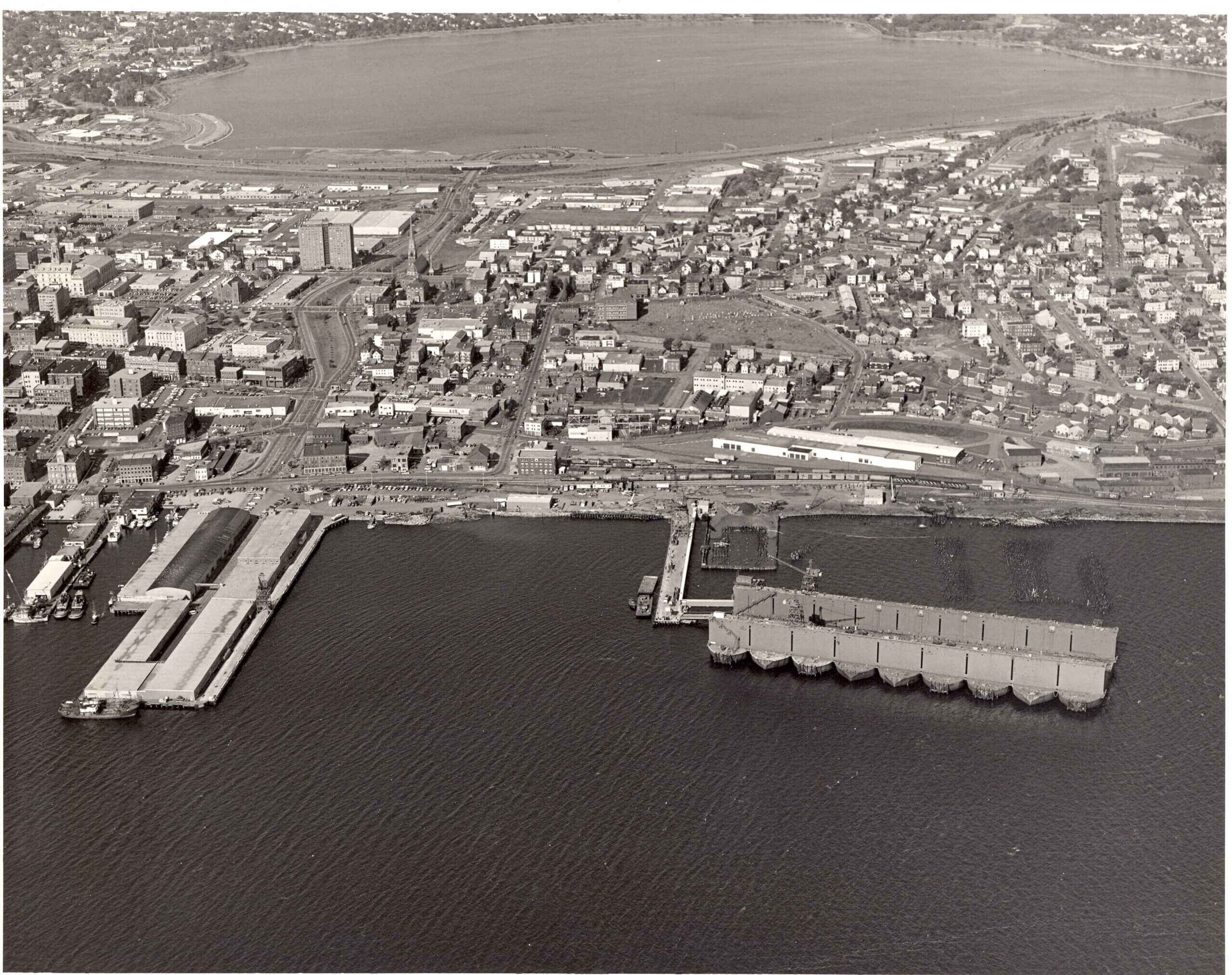
From 1982-2001, BIW leased the BIW Portland Repair Yard from the City of Portland. The Repair Yard came with a World War II era floating drydock. Nicknamed “the Hog,” the…
-
Outfit Fabrication Facility
In 1989, the Pipe Shop and Tin Shop fabrication operations were moved from the main shipyard in Bath to the East Brunswick Manufacturing Facility (EBMF), now known as Outfit Fabrication.

-
Crane Lift
The heaviest crane lift recorded at the shipyard was more than 900 tons in 2012 when the complete DDG 1000 deckhouse was lifted with four cranes – two of them…
-
HSTC-1
Thirty seven years ago this month, BIW delivered HSTC-1 – at the time, the largest barge built in the United States. Built for the California & Hawaiian Sugar Co., the…
-
Water Street
The original location of the business that would eventually become Bath Iron Works was on Water Street, north of Centre Street, an area now occupied by the municipal parking lot…
-
Modern Era – 2015
BIW Operating Crew performs nighttime rescue of Captain in a medical emergency
On Dec. 7, 2015, the first of the Zumwalt-class destroyers left BIW for its initial sea trials, a memorable trip that made international headlines when five days in, the BIW…
-
Origin of the Serapis flag on the crest of the USS John Paul Jones (DDG-53)
During the Revolutionary War, U.S. Navy Captain John Paul Jones captured British frigate Serapis and sailed to the neutral Dutch port of Texel. Britain said Jones was a pirate since…
-
Reconstruction of the USS Belknap (CG 26)
On this January 30, 1976, reconstruction began on USS Belknap (CG 26), which was severely damaged during a fatal fire. Because the fire would’ve caused less damage if the superstructure…
-
Great Depression and WW II – 1941
USS Calypso (AG-35) Carries Franklin D. Roosevelt and Prime Minster Winston Churchill
In July of 1941, Bath-built USS Calypso (AG-35) set out for Nova Scotia. During a portion of the trip she carried President Franklin D. Roosevelt, who was headed to the…
-
Great Depression and WW II
Liberty Ships
During World War II, BIW delivered 244 Liberty Class and 30 Ocean Class cargo ships. Deliveries in 1943 and 1944 averaged 1.8 ships per week. Combined, all US shipyards delivered…
-
Great Depression and WW II
Crew of the USS O’Bannon (DD-450) won a battle against a Japanese submarine with the help of potatoes
On April 5, 1943, Bath-built USS O’Bannon (DD-450) won a battle thanks to a well-known Maine product. DD-450 found itself parallel to a Japanese submarine. It was in danger because…